

Navigating reproductive health, emotional wellness, and the complexities that accompany major life transitions can feel overwhelming, but no one needs to go through it alone. In this episode, host Lana Doan speaks with Sandra Pelka (MSW, RSW) to explore the emotional, psychological, and practical support available to individuals facing fertility challenges, grief, relationship stress, or significant changes in family planning. Together, they engage in an honest conversation about creating space for healing, compassion, and greater access to care.
Understanding EMDR: A Different Way to Heal
EMDR (Eye Movement Desensitization and Reprocessing) is often misunderstood, yet it’s one of the most powerful trauma-informed modalities available today. In this episode of Anchored Minds, Lana sits down with Sandra Pelka, a seasoned therapist with 30 years of experience, to break down how EMDR works, why it’s effective, and who it can help. Sandra explains that EMDR isn’t just for PTSD; it can be beneficial for anyone carrying tension, stored emotions, or unprocessed life experiences.
“It is a psychotherapeutic modality and what it does is it assists a person… when we go through the phases it opens up neuropathways that are in our brains and it’s where we store information.”
What EMDR Helps Address:
- PTSD & complex trauma
- Emotional dysregulation
- Childhood wounds and attachment injuries
- Stored sensory memories
- Anxiety, overwhelm, or chronic patterns that “don’t make sense.”
Adaptive Information: What It Really Means
That’s where we understand that if this incident wasn’t my fault, I don’t have a responsibility or it’s over and I am now safe.”
Examples of Adaptive Information:
- “I was a child, it wasn’t my responsibility.”
- “My body is safe now, even if it didn’t feel safe then.”
- “It’s okay for me to feel calm.”
- “This emotion is valid, but it no longer controls me.”
The 8 Phases of EMDR: What Actually Happens in a Session
Sandra explains that EMDR is a comprehensive therapeutic framework consisting of eight phases. Only one of those phases involves bilateral stimulation.
“People tend to think about EMDR therapy only as the phase four… there are multiple phases.”
The 8 Phases of EMDR (Explained Simply)
History Taking – Understanding life experiences, belief systems, and somatic patterns.
Preparation – Teaching grounding, breathing, visualization, resourcing.
Assessment – Identifying targets and understanding tolerance levels.
Desensitization – Using bilateral stimulation to access neural pathways.
Installation – Strengthening adaptive, positive beliefs.
Body Scan – Noticing where tension still lives in the body.
Closure – Shutting down reprocessing safely.
Re-evaluation – Checking for remaining triggers or new targets.
The Window of Tolerance: Understanding Your Emotional Range
A key part of EMDR is helping clients understand their “window of tolerance”, the range where the nervous system remains regulated. When life pushes us outside that window, we can enter states of hyperarousal or collapse.
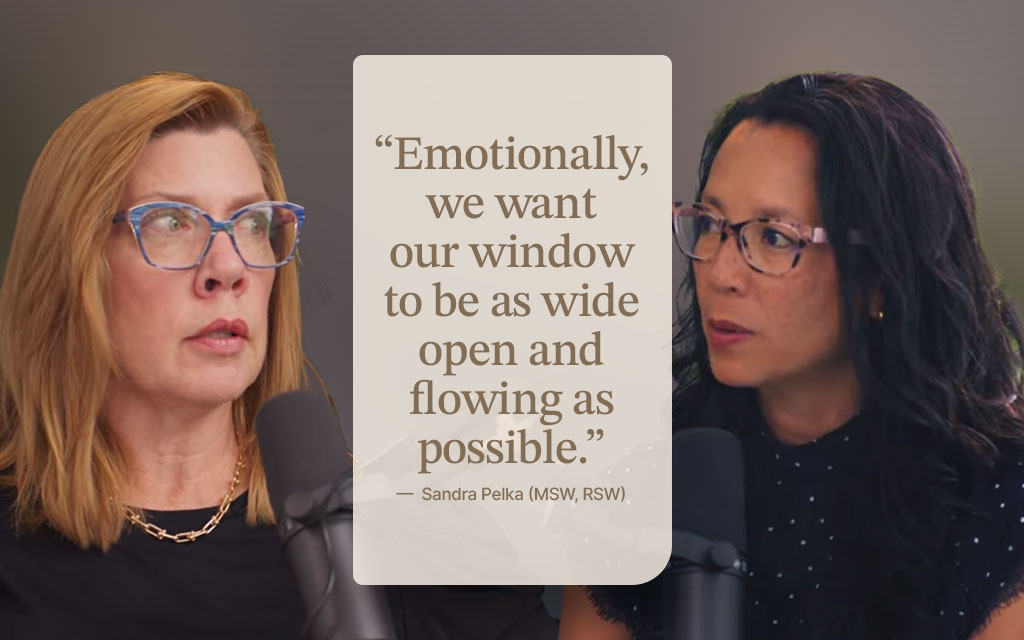
The Window of Tolerance: “Think of ourselves and our system as a window… emotionally, we want our window to be as wide open and flowing as possible.” — Sandra Pelka (MSW, RSW)
Signs You're Outside Your Window
- Hyperarousal (fight/flight):
- Racing thoughts
- Irritability
- Panic or overwhelm
- Feeling “on edge”
- Hypoarousal (freeze/collapse):
- Numbness
- Depression
- Lack of motivation
- Feeling disconnected or exhausted
Somatic & Polyvagal Work: Healing Through the Body
Somatic theory… it’s all about body work. And ‘somatic,’ just the name itself, tells me that it’s related to the body.”
Somatic Tools Clients Learn
- Grounding exercises – Placing both feet firmly on the floor, noticing the support beneath you, and gently pressing your palms together. This helps you reconnect with the present moment and signals safety to your nervous system.
- 5-4-3-2-1 sensory technique – This exercise gently pulls your brain out of overwhelm and into the present, helping calm your system.
- 5 things you can see (a window, your hands, a plant, the floor, a light)
- 4 things you can feel (your clothing, your chair, your feet on the ground, your hair)
- 3 things you can hear (a fan, distant traffic, your breath)
- 2 things you can smell (coffee, fresh air)
- 1 thing you can taste (a sip of water or the lingering taste in your mouth)
- Breathwork (counted breathing) – Inhale through your nose for a count of four, hold for two, and exhale slowly for a count of six. This technique supports emotional regulation and helps calm the nervous system.
- Yoga or gentle movement – Engage in simple movements like shoulder rolls, neck stretches, or slow seated twists to release tension. These small motions help clients safely reconnect with their bodies.
- Guided meditation – Participate in a short, therapist-led visualization, such as imagining a warm light moving through your body. This practice promotes calm, clarity, and self-connection.
- Orienting to the present moment – Take a moment to look around the room and notice the colors, shapes, and objects in your environment. This helps your brain recognize that the present moment is safe and supports grounding.
Parts Work & Attachment: Why Childhood Still Matters
Sandra explains that even individuals who believe they had a “good childhood” still carry unmet emotional needs. EMDR helps uncover parts of ourselves that are stuck in old memories, not to place blame, but to facilitate healing.
“Our families of origin… It is those original caregivers who raise us that shape our nervous system.”
Parts Work enhances Eye Movement Desensitization and Reprocessing (EMDR) by helping individuals heal inner child wounds that affect their reactions. It provides a framework for understanding conflicting feelings and fosters self-compassion, crucial for healing. By connecting current triggers to past experiences, Parts Work improves emotional understanding and regulation during therapy, facilitating effective processing of traumatic memories.
Closing Thoughts
“When we hold space for someone’s story without judgment or pressure we help them rediscover their strength, clarity, and hope.”
Find the Support You Deserve
If you are looking for more information on this topic, Lana can provide grounded, empathetic insights specifically tailored to your needs.
For more information, please contact Lana Doan today.